

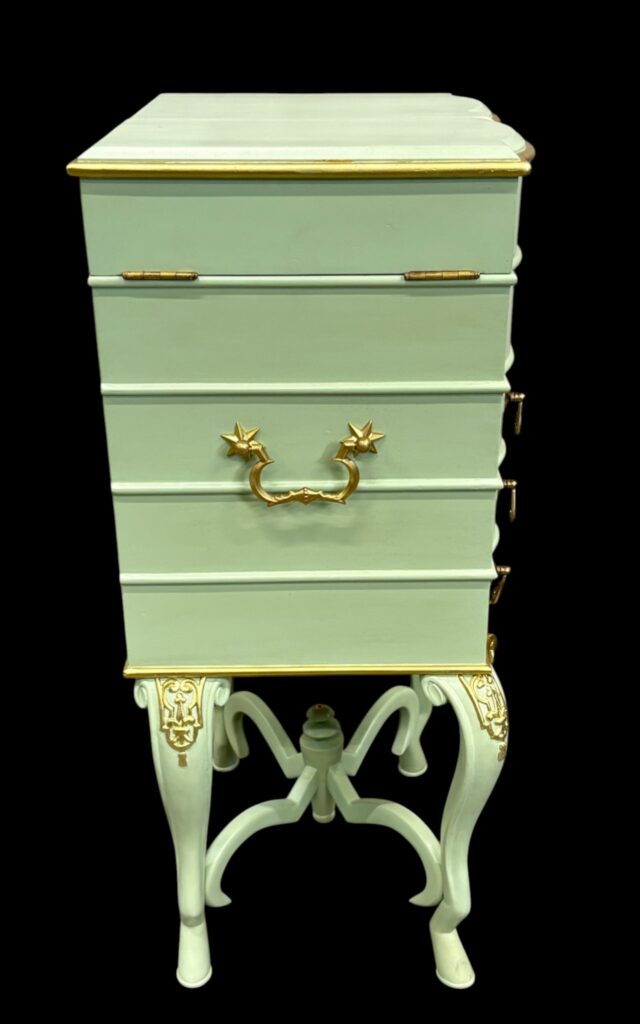


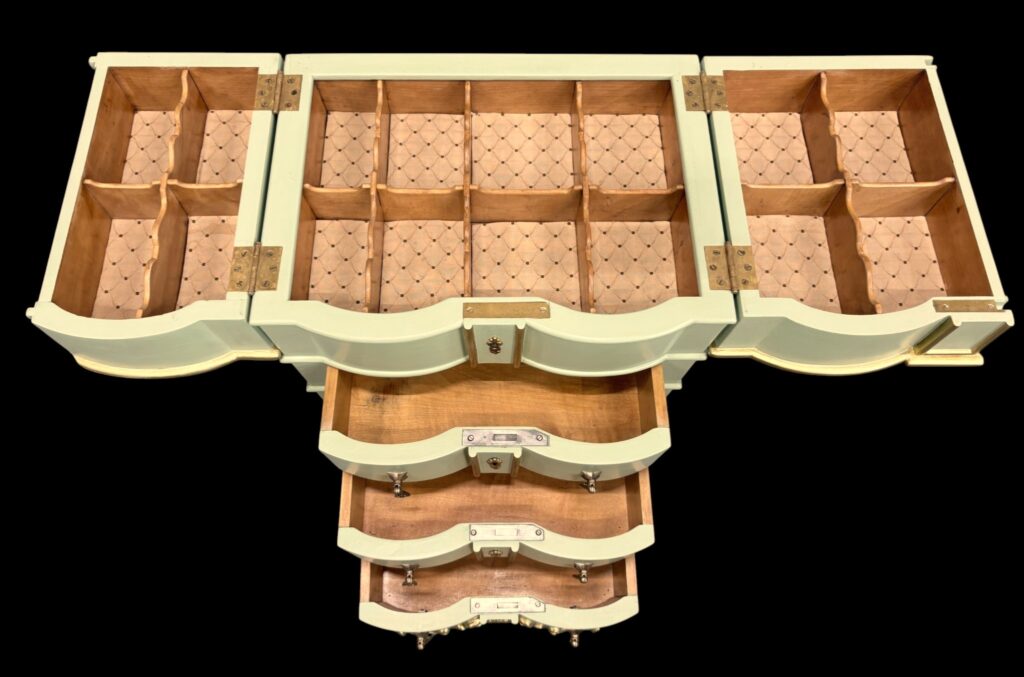
Perfume cabinet designed by Lajos Kozma
Circa 1925. Beechwood base with green painted finish, gilded edges, cast brass handles and fittings. Professionally restored condition.
Size: 83,5 x 49 x 40 cm
Literature: Judith Koós – The work of Lajos Kozma, page 125 – figure 149 Dressing room 1922 Museum of Applied Arts – Art Deco and Modernism: page 116 / figure 1.8 Lajos Kozma (born Lajos Fuchs) (Kiskorpád (Kaposszéplak puszta), June 8, 1884 – Budapest, Erzsébetváros, November 26, 1948) was an architect, applied artist and graphic designer, university professor. His master was Béla Jánszky. Between 1909 and 1910 he studied painting in Paris under Henri Matisse as a scholarship student. As a member of the Young Ones group, he represented a vernacular Art Nouveau direction influenced by Károly Kós. Together with Károly Kós, Dénes Györgyi, Béla Jánszky and others, they aimed to create a modern yet nationally rooted architecture. They collected folk architectural and decorative motifs from Somogy County and Transylvania and incorporated them into their designs.
Between 1910 and 1913 he led the design office of Béla Lajta. He executed the Biedermeier interior design works of the now-destroyed Rózsavölgyi House in 1912 based on Lajta’s plans. This marked the beginning of his applied arts career. He created functional and furnishing objects for the New York Palace as well. In 1913 he became a teacher at the School of Applied Arts and founded the Budapest Workshop, aiming to reform domestic interior design. His furniture designs became known as “Kozma Baroque” in the 1920s. In 1925 he was awarded the Grand Gold Medal of Applied Arts, while his style was already moving toward Art Deco. After 1919 he continued as an independent designer, increasingly focusing on architecture.