
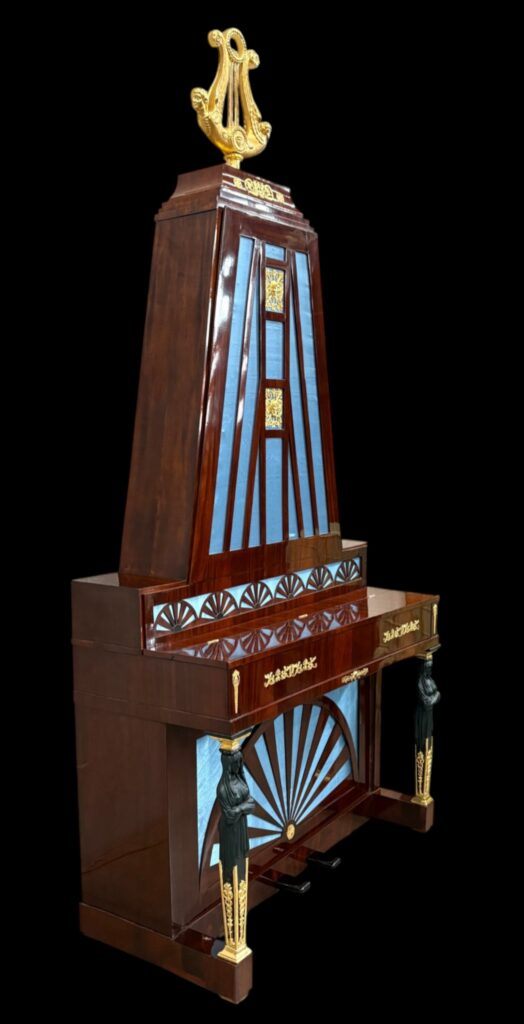


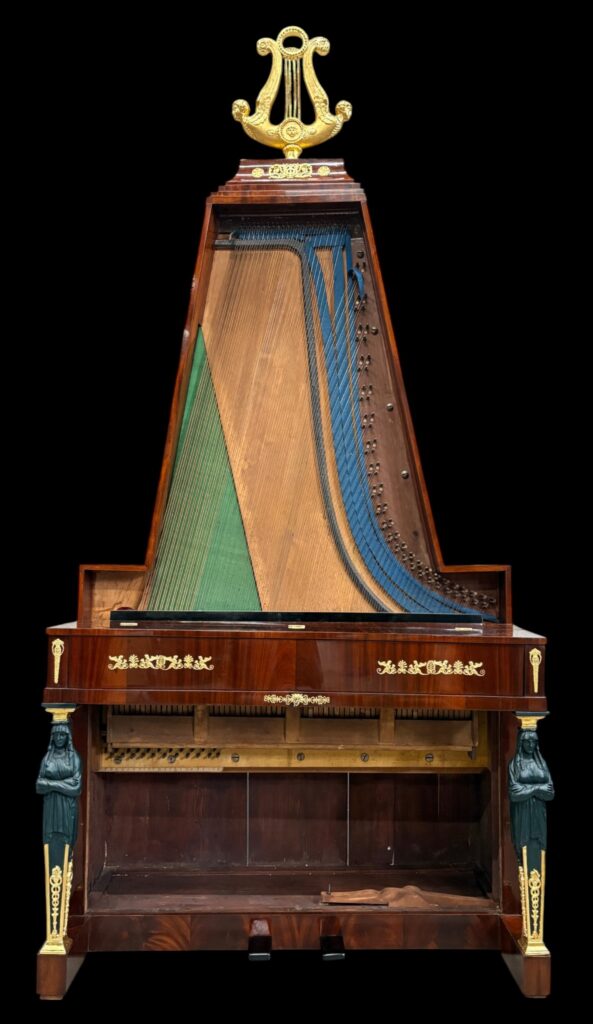




Empire pyramid piano
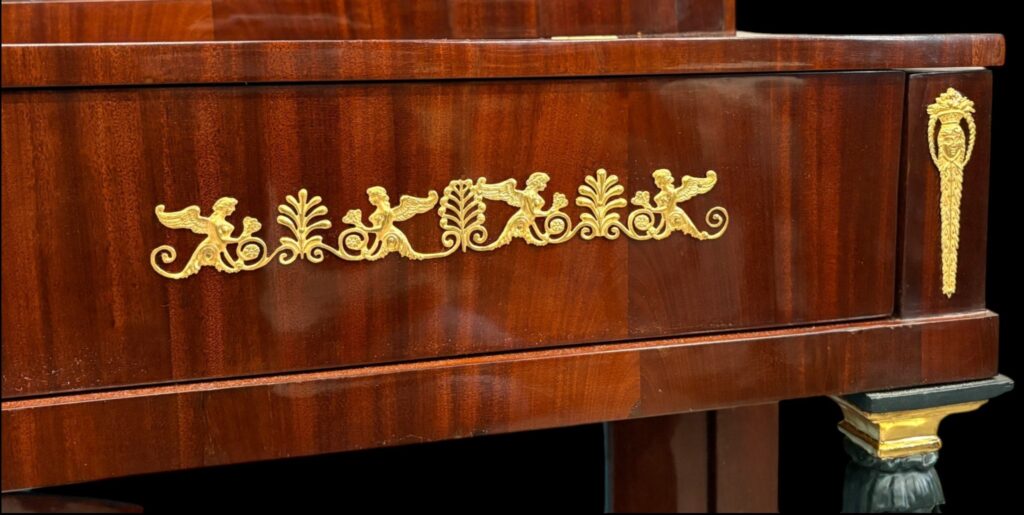
Austria, Vienna, circa 1820. A unique museum-quality piece made in Empire style around 1820 by Joseph Wachtl in Vienna, approximately between 1820–1825. Pine body with mahogany veneer. The front features a pair of partially fire-gilded caryatids with so-called “verde antico” decoration. The top is adorned with a fire-gilded lyre combining matte and polished surfaces, with putto heads. The front is decorated with fire-gilded bronze appliqués. The interior is finished with ebonized ebony and mahogany veneer. Ivory-covered keyboard. The mechanism is present but not restored. The exterior has been restored. Marked: “Joseph Wachtl” on an enamel plate within a fire-gilded frame.
Size: 246 x 113 x 54 cm
WACHTL, Joseph (active 1803–1832). Probably a pupil of Anton Walter; later a piano and organ maker in Vienna. Wachtl founded his business in 1802 after becoming a resident of Vienna. Together with Franz Martin Seuffert and the Hungarian Jakob Bleyer, also a pupil of Walter, he established the company Wachtl & Compagnie. A pamphlet from their collaboration states that artificially dried wood is superior to naturally dried wood. Before being placed in the drying chamber, the wood was steamed for 48 hours using salt water to remove accumulated resin from the resonant material. In cooperation with Jakob Bleyer, Wachtl developed the so-called “giraffe” piano, an early and distinctive type of piano. Until 1811 he continued manufacturing pianos with both partners, but eventually they separated due to disputes over patent rights. In that year Seuffert left the company. Shortly thereafter Wachtl married Theresia, the half-sister of his colleague Bleyer, who died in 1812. When Wachtl became a citizen and master in May 1805, he lived at Laimgrube, Kothgasse 27. Between 1808 and 1812 he lived at Laimgrube 30, and in 1823 at Wieden, Hechtengasse 282. After 1812 Seuffert’s name disappeared from the instruments, and until 1820 the names Wachtl and Bleyer appeared. It is likely, however, that some instruments bearing these names date from an earlier period. According to Hirt, Wachtl dissolved his company in 1832, and it disappeared from directories after 1835. All dates related to instruments made by Wachtl alone or with partners must be treated with great caution.